
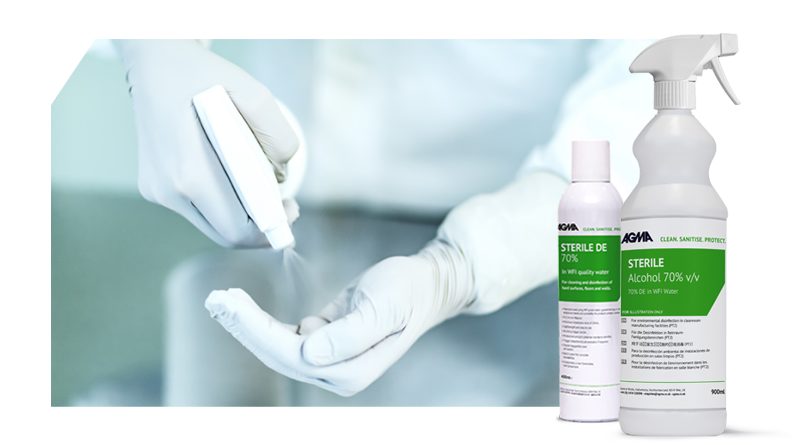

When selecting a disinfectant for a cleanroom, whether it be in pharmaceuticals, biotech, microelectronics, or medical device production, an important aspect to consider is the product format. Options include trigger spray bottles or aerosols used to spray and wipe, pre-saturated wipes, mopping systems, pressurised spray systems or automated vapour bio-decontamination.
This blog focuses on the advantages and disadvantages of trigger spray bottles and aerosols.
Trigger sprays and aerosols are commonly used in many cleanroom settings to deliver disinfectants, particularly for smaller surfaces. They both offer distinct advantages to one another.
Trigger Sprays
Trigger sprays dispense liquid through an adjustable nozzle, which can be either as a spray or a jet. They deliver the liquid exactly where it is needed, reducing airborne droplets, making them ideal for cleaning specific areas. Trigger sprays dispense all liquid, so there is no wastage making them cost effective.
In comparison to aerosols, the droplets produced from a trigger spray are much larger and therefore settle more quickly and don’t stay suspended, which means no added airborne particulate load – critical in controlled grade cleanrooms. Trigger sprays reduce inhalation of fine droplets and vapours, which benefits operator safety.
Trigger sprays tend to produce less wasted product and residue, reducing chemical footprint and overall cost.
Bag-in-bottle trigger spray systems offer additional advantages by separating the formulation from the propellant, preventing air from entering the container during use. This maintains product integrity, supports consistent sterility, and allows near-complete evacuation of the contents. The technology also enables 360° spraying, ensuring effective application even when the bottle is inverted or angled.
Aerosols
Aerosols deliver a finer, more even and continuous mist that can cover larger, more open areas efficiently compared to trigger sprays. They don’t require constant pumping, which can make them more operator-friendly, especially over large areas. Aerosols can reach difficult to access areas much more easily than trigger sprays.
As aerosols are closed systems, they can offer effective sterility as the closed system prevents air from entering the container and contaminating the contents during use.
Summary table to help you to decide which would be most suitable for your application:
Trigger Spray |
Aerosol |
|
Sterility |
Varies (Use, specialised for high sterility) | High (Closed System) |
Droplet Size |
Larger >100µm | Smaller <50µm / Fine mist |
Coverage |
Targeted / precise | Wide area / fast |
Operator Safety |
Low VOC emission | High VOC emission / Inhalation risk |
Waste/Cost |
No waste / lower cost | More waste / special disposal |
Best for |
Targeted areas / vertical surfaces | Larger open areas / hard to reach places / horizontal surfaces |
Pack Size / Ergonomics |
Varied – for example: 1L, 900 ml, 500ml |
Varied but 400 ml is a standard / popular size |
Summary
While trigger sprays are generally cheaper over time, aerosols can be useful for tasks that require a precise, fine mist or heavy-duty consistent coverage.
Both trigger sprays and aerosols play an important role in cleanroom disinfection strategies. Trigger sprays provide excellent control, operator safety, and strong sustainability credentials, especially when paired with bag-in-bottle technology.
Aerosols, on the other hand, excel in delivering rapid, uniform coverage, accessing difficult-to-reach areas, and the lighter weight can support operators to reduce repetitive strain injury.
Selecting the right format ultimately depends on the application, cleanroom grade, and operational priorities.
View our full range here: AGMA Healthcare